


 Year 1
Foundations
Programming, mathematics, how computers work. The Drawing Board starts here. You build a shell, an interpreter and your first real tools.
4-year residential B.Tech in Computer Science & AI
Your B.Tech will be awarded by a UGC-recognised university.
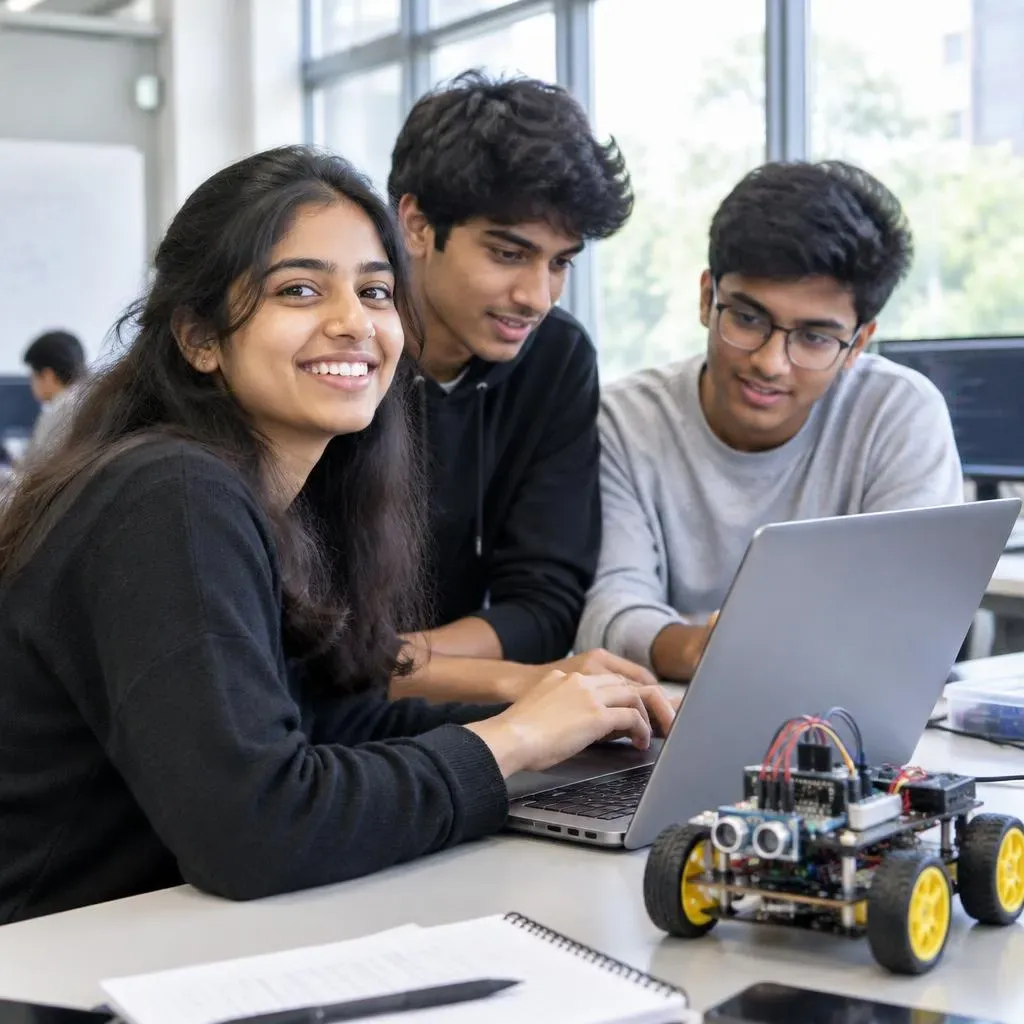
The world's best computer science lectures are already free online: operating systems, networks, compilers, databases, architecture, AI. Almost nobody finishes them alone. Trevor is four years on one campus where that curriculum turns into 40+ things you actually build. Your batchmates are working on the same hard problems, and the engineers here read your code. You graduate with a B.Tech and the work to prove it.
No spam calls. No "only 3 seats left" panic. Talk to us when you're ready, and bring your parents.

trevor@campus:~ (Lab 2, 2:14 AM)
Terminal output: ./myOS boot. loading kernel... initialising scheduler... PANIC: deadlock detected. trace saved. read it. fix it. 3 batchmates in Lab 2 have hit this before.
Enough to pass.
Not enough to build.
Curriculum benchmarked against publicly available courseware from MIT, Stanford, Berkeley, CMU and the IITs. We studied their public materials.
No affiliation implied.
We didn’t invent the syllabus. Nobody needs to, because the best ones are already public. What we built is the place where you actually finish it.
The part nobody advertises
You pick CS because you want to build things.
Then Semester 1 happens. Lab records. Lecture notes. Exams that reward remembering over making. You tell yourself, "It'll get better next year."
Often, it doesn't.
By third year, you've submitted dozens of assignments and very little you'd show a stranger. You know what a semaphore is, but you've never written one. You've "done" DBMS, but you've never watched a schema buckle under load and learned why indexes exist.
So you buy a course. Then another. You grind 300 LeetCode problems and still freeze when someone asks, "Okay, but how would you design this?" Nobody taught you to design. Only to submit.
Meanwhile, the brochures keep arriving. Glossy campus. Big logos. One very large number in bold. AVG. Package
Yes, we have a campus too. So ask every college these three questions, including us:
“Show me something your second-years built.”
“Show me the median, not the highest, and tell me whose students it came from.”
“Let me talk to a student without you in the room.”
And then there's the question that shows up late at night:
"What if I'm 22, have a degree, and still can't build anything?"
Don't ignore that question. Answer it. You have four years.
Our position
For decades, engineering colleges across India, the IITs included, have made first-years take Engineering Drawing. Even the computer science kids. Most of them will never draw an isometric projection at work. Most of them complain about it. They’re missing what it’s for.
Engineering Drawing exists because the person who designs a thing and the person who builds it are rarely the same person. A drawing has to say exactly what to make: every dimension, every hidden edge, from every side. Someone else must be able to build it without asking you a single question. One ambiguous line and the part comes back wrong.
That used to be a mechanical engineer’s problem. It’s about to be yours.
AI is now the one doing the building. It writes the React component in four seconds, and it builds exactly what you described, including the parts you described badly. The engineer who gets paid is the one who can specify the system precisely. They look at it from every view (data, failure, load, cost) and find the hidden line before it ships.
Data
What’s stored, where, and who owns it?
Failure
What breaks first, and then what?
Load
What changes at 100× the traffic?
Cost
What does it cost to run?
That’s not a framework. That’s a drawing. And you can only draw what you understand.
The new-age playbook skips the “boring” parts: Theory of Computation, Compilers, Computer Architecture. It teaches React in week three, print a big number, move on.
We think that's exactly backwards. Especially now.
Frameworks expire.Fundamentals compound.
The Drawing Board
ConfirmBefore you write the code, and before you open an AI assistant, you defend your design to a reviewer. You explain the views, the interfaces, and where it will break. First-years do it for a shell. Fourth-years do it for a distributed system. By graduation, specifying exactly what to build is the most natural thing you do.
Exit matrix
Same B.Tech. Different four years.
Why residential · The precedent
Between 2011 and 2012, Scott Young worked through 33 courses from MIT’s computer science curriculum in about a year, using free public courseware.
0
MIT CS courses
~0
months
Free
public courseware
He proved the curriculum was never the scarce thing.
He’s also the exception, and that’s the part nobody mentions. For every Scott, countless people open the same free lectures and stop a few weeks in. They aren’t less capable. Nobody was in the room with them.
What’s missing is:

That’s why Trevor is residential.
Not for the hostel. For the room.
Curriculum
Year 01
Foundations
Sem 1
Programming in C (Foundation)
You build: CLI tools: wc, grep, hexdump
Discrete Mathematics (Foundation)
You build: a logic puzzle solver
Calculus & Linear Algebra (Foundation)
You build: a matrix library
Digital Logic (Foundation)
You build: an ALU in a simulator
Sem 2
Data Structures (Core CS)
You build: your own standard library
Systems Programming (Systems)
You build: a Unix shell
Programming Languages I (Core CS)
You build: an interpreter
Computer Organisation (Systems)
You build: a CPU emulator
Probability & Statistics (Foundation)
You build: a Monte Carlo simulator
Year 02
Core systems
Sem 3
Algorithms (Core CS)
You build: a route planner on real map data
Operating Systems (Systems)
You build: myOS: a kernel and scheduler
Theory of Computation (Core CS)
You build: a regex engine
Software Construction (Core CS)
You build: your own git
Sem 4
Database Systems (Systems)
You build: a relational database
Computer Networks (Systems)
You build: a TCP stack
Optimisation for ML (AI/ML)
You build: an optimiser library
Open Source Studio (Core CS)
You build: your first merged PR
Year 03
Industry
Sem 5
Compilers (Systems)
You build: a compiler for a C subset
Machine Learning (AI/ML)
You build: a neural net from scratch
Distributed Systems (Systems)
You build: a replicated key-value store
Track Elective I (Advanced)
You build: a track project
Sem 6
Deep Learning (AI/ML)
You build: a transformer from scratch
Information Retrieval (AI/ML)
You build: a search engine
Computer Security (Systems)
You build: exploit, then patch, a binary
Track Elective II (Advanced)
You build: a track project
Year 04
Depth
Sem 7
System Design at Scale (Advanced)
You build: a defended design review
Track Elective III (Advanced)
You build: depth work with a mentor
Capstone I (Advanced)
You build: your capstone: spec + prototype
Sem 8
Capstone II (Advanced)
You build: your capstone: shipped + demoed
Track Elective IV (Advanced)
You build: advanced track work
44 courses. 4 years. One campus. You’ll have built the machine, not just used it.
How the four years work
Year 1Programming, mathematics, how computers work. The Drawing Board starts here. You build a shell, an interpreter and your first real tools.
 Year 2
OS, networks, databases, algorithms. You build a database, a TCP stack, and you get your first open-source contribution merged.
 Year 3
Specialisation begins, and so does real work. A 3-month summer internship, with a stipend paid by the host company, typically ₹20,000–₹40,000 a month.
 Year 4
Capstone, advanced track work and a 9-month industry residency on production systems. You graduate with a B.Tech and a public body of work.
Internships are earned through company interviews, not handed out. We get you ready and open the doors. Walking through them is on you. Don't land one? You'll work on an in-house industry project with a mentor, and we'll keep putting you in front of companies.
Build log
Pipes, redirection, job control and signals. The first program you write that argues with the kernel.
Reviewed by: practising engineerConfirm
Lexer, parser and a tree-walking evaluator for a small language with closures. Stack traces stop being scary.
Reviewed by: practising engineerConfirm
Your own git: content-addressed storage, commits, branches and a three-way merge. Then you submit everything with it.
Reviewed by: practising engineerConfirm
malloc and free from scratch. Fragmentation stops being a textbook word and becomes your problem.
Reviewed by: practising engineerConfirm
Boot, paging, processes and a scheduler. It will deadlock at 2 AM. You will read the trace. You will fix it.
Reviewed by: practising engineerConfirm
Pages, a B+ tree, a query planner and transactions. Load it until it breaks, and learn exactly why indexes exist.
Reviewed by: practising engineerConfirm
Raw packets in, reliable streams out. Handshakes, retransmission and congestion control, on a real interface.
Reviewed by: practising engineerConfirm
Source text to machine code: parsing, type checking, an IR and register allocation. The machine stops being magic.
Reviewed by: practising engineerConfirm
An autograd engine, backprop by hand, and a network trained on nothing but arrays and patience. No frameworks.
Reviewed by: practising engineerConfirm
Raft consensus, leader election and log replication. Then you kill nodes on purpose and watch it survive.
Reviewed by: practising engineerConfirm
A crawler, an inverted index and a ranking function that answers queries over a million pages in milliseconds.
Reviewed by: practising engineerConfirm
Tokeniser, attention, training loop. A small language model you can explain line by line, because you wrote every line.
Reviewed by: practising engineerConfirm

13Capstone
One thing nobody asked for.
Your capstone. Your idea. We review the code, and your batch shows up to the demo.
Each one comes with a spec, a test suite, a difficulty rating and a “you’re stuck, read this” guide. No video hand-holding.
Struggle is the feature. Struggling alone isn’t.
A spec
A test suite
A difficulty rating
A “you’re stuck, read this” guide
Tracks
For people who want to know why it’s slow.
Track 01Models from scratch before models from APIs.
Track 02For people who like problems with exact answers.
Track 03For people headed to an MS or PhD.
Track 04For people who want to ship to strangers.
Track 05Who teaches you · Faculty
Every name here is a real person, with their full background one click away. Visiting mentors are labelled as visiting, and advisors are never presented as faculty.

The founder
Founder, Trevor School of CS & AI
In his words
“I build systems — engineering, content, and growth ones.”
A walking contradiction: a biomedical engineer who learned assembly, Verilog and Prolog, then grew two new-age colleges through growth experiments. Now he’s building Trevor.
Full-time faculty04

Software Engineer, stealth quant trading firm
Full-stack engineer and NIT Raipur graduate who has built developer tools, apps and browser extensions used by over 25,000 people.
In his words
“Passionate about creating innovative solutions that solve real-world problems.”

Product Manager, GreyB
Product manager who worked with the founding team at a Y Combinator-backed startup, owning the full user journey from acquisition to retention.
In his words
“Generalist across Product, Operations, and Growth.”

PhD Researcher, Tallinn University of Technology, Estonia
Biotechnologist doing his PhD in Estonia after an M.Tech at IIT Guwahati, with two patent applications and published research on low-cost, plant-based materials for tissue engineering.
Words he keeps close
“Opportunities don’t happen, you create them.”
— Chris Grosser

Industrial & Product Designer, M.Des DTU
Civil engineer turned product designer with a master’s in design from DTU, working across physical products, automotive concepts and AI-assisted design.
Ask him about
The lamp he made by blending Rajasthani shellac bangle craft with modern woodworking.
Visiting mentors04
Visiting mentorWhy we label visitors: so you always know who teaches here full time, and who joins from industry and research labs abroad.

Sr. Power BI Developer, Verizon
Senior data analyst with 10+ years in the US, building analytics and reporting systems for telecom, healthcare, finance and public transit.
Ask him about
Building the operations and ridership dashboards for Washington Metro.

Robotics Field Engineer, Maven Robotics
Robotics engineer in the San Francisco Bay Area who deploys and tests real robots in the field. He has a master’s in robotics from the University at Buffalo.
In his words
“As a robotics engineer, I am passionate about connecting the dots between ideas, people, and applications.”

Postdoctoral Researcher, Karlsruhe Institute of Technology (KIT), Germany
IIT Madras PhD in solid mechanics, now a postdoctoral researcher in Germany building computer models of the human heart. He spent nine years across IIT Hyderabad and IIT Madras.
Ask him about
Simulating how the human heart behaves, with mechanics, blood flow and electrical signals in one model.

Software Developer, GE HealthCare
Software engineer at GE HealthCare building secure communication systems for medical technology. Electrical engineer from NIT Raipur, and a cybersecurity and motion design enthusiast.
Ask him about
Securing how healthcare systems talk to each other, with TLS and mTLS through the Kong API Gateway.
Advisors
Senior academics from NIT Raipur, with doctorates from IIT Roorkee, IISc Bangalore and Jadavpur University. They advise Trevor; they aren’t full-time faculty, and we label them that way.

Associate Professor, Civil Engineering, NIT Raipur
Earthquake engineer with a PhD from IIT Roorkee, advising state disaster management and rural housing bodies on building safer structures.
In his words
“God and Work.”

Associate Professor, Biomedical Engineering, NIT Raipur
IISc PhD in medical imaging who built NIT Raipur’s innovation and startup ecosystem from the ground up, and now leads its space exploration centre.
In his words
“Innovation Enabler | Science Educator | Researcher”

Head of Department, Biomedical Engineering, NIT Raipur
Marie Curie Fellow and tissue engineering researcher, building lab-grown tissue and point-of-care diagnostic devices with partners in eight countries.
In his words
“Nature is the broadest subject to learn and enjoy. And society is the greatest platform to serve.”

Professor of Physics, NIT Raipur
Materials physicist with 25+ years in research and teaching, working on next-generation solar cells. He has guided 9 PhDs and published 80+ international journal papers.
Off the clock
Sixteen years (2009–2025) leading RAAGA, NIT Raipur’s music club, and ten running its SPIC MACAY chapter.
Inspiration
None of them is affiliated with Trevor. They’re the people whose ideas shaped how we teach, starting with the one we’re named after.

Why we’re called Trevor
Professor Emeritus of Statistics and Biomedical Data Science, Stanford University
The idea we took
The best tools come from people who move between fields.
Hastie took statistics into medicine and genomics, and showed that rigorous maths and real-world problems belong together.
Trevor’s founder comes from biomedical engineering. Hastie’s career, at the meeting point of data and medicine, is the kind of cross-disciplinary thinking the school is named after.

Co-founder of PayPal and Palantir, first outside investor in Facebook
The idea we took
Don’t compete. Create.
We want students to build things that don’t exist yet, not chase the same jobs as everyone else.

Co-founder and CEO, Palantir Technologies
The idea we took
You don’t need a computer science degree to build a technology company.
Some of the best builders come from outside the expected path. We want to teach people from every background to build, not just engineers.

Father of Information Theory, Bell Labs
The idea we took
Deep, simple ideas outlast every trend.
Every system our students build, from a TCP stack to a compiler, rests on his work. It’s the clearest case we know for fundamentals over frameworks.
No affiliation or endorsement implied.
Campus & life · The room
Build nights. Hackathons. Demo days. Clubs that actually ship things. And batchmates who’ll still be building with you ten years from now.
You’re not choosing a hostel. You’re choosing who sits next to you for four years.
Outcomes
Our first batch graduates in 2031. Until then, we won’t show you numbers from other programs and call them ours.
What we’ll show you instead, every semester:
What students built
Awaiting first entries · published every semester
Where they interned
Awaiting first entries · published every semester
What the median looks like, with methodology, once there is one
Awaiting first entries · published every semester
Self-selection note
This is for you if:
This is not for you if:
We’d rather have 100 students who finish than 10,000 who enrol.

The same recognised degree
B.Tech in Computer Science & AI, awarded by a UGC-recognised university
For parents
Your child earns a B.Tech in Computer Science & AI, awarded by a UGC-recognised university.Confirmrecognition details What changes is how the four years are spent: more fundamentals, more building, real industry exposure, and a campus where the norm is hard work.
We are not removing rigour. We’re putting it where employers look for it.
Covered on this page or in the Parent Guide:
Fees & scholarships
We won’t sell you a promise. We’ll show you the price, the work, and, when our first batch graduates, the median.
Fee statement
B.Tech CS & AI · 4 years
Scholarships
Loans and instalments
Internship stipends
Admissions
Eligibility
Class 12 with Physics and Mathematics, minimum marks
Important dates
Applications open: 1 December 2026
TRACE dates: 18 January, 15 March and 10 May 2027
Final deadline: 15 June 2027
Program begins: 2 August 2027

Talk to us when you’re ready,
and bring your parents.
The process
Fee: ₹500
Reasoning and mathematics, not memorised syllabus.
Your rank measured one exam. We measure something else.
From the blog
 Campus
1 min read
The world’s best computer science courses are already free online. Almost nobody finishes them alone. Here’s why we built Trevor around a room, not a recording.
1 min read
The new-age playbook skips Theory of Computation and Compilers to teach React in week three. We think that’s exactly backwards, especially now.
1 min read
Engineering colleges have made first-years take Engineering Drawing for decades. Here’s why the same idea is now the most important skill a software engineer can have.
FAQ
No pressure calls. Talk to us when you’re ready, and bring your parents.
Either into attendance registers and a certificate nobody reads,
or into a GitHub profile that makes the interview a formality.
The curriculum is public. The projects are waiting. The most expensive thing you can spend isn’t a fee. It’s four years of hoping it gets better.
No pressure calls. Talk to us when you’re ready, and bring your parents.